Dentures vs Implants: What You Need to Know
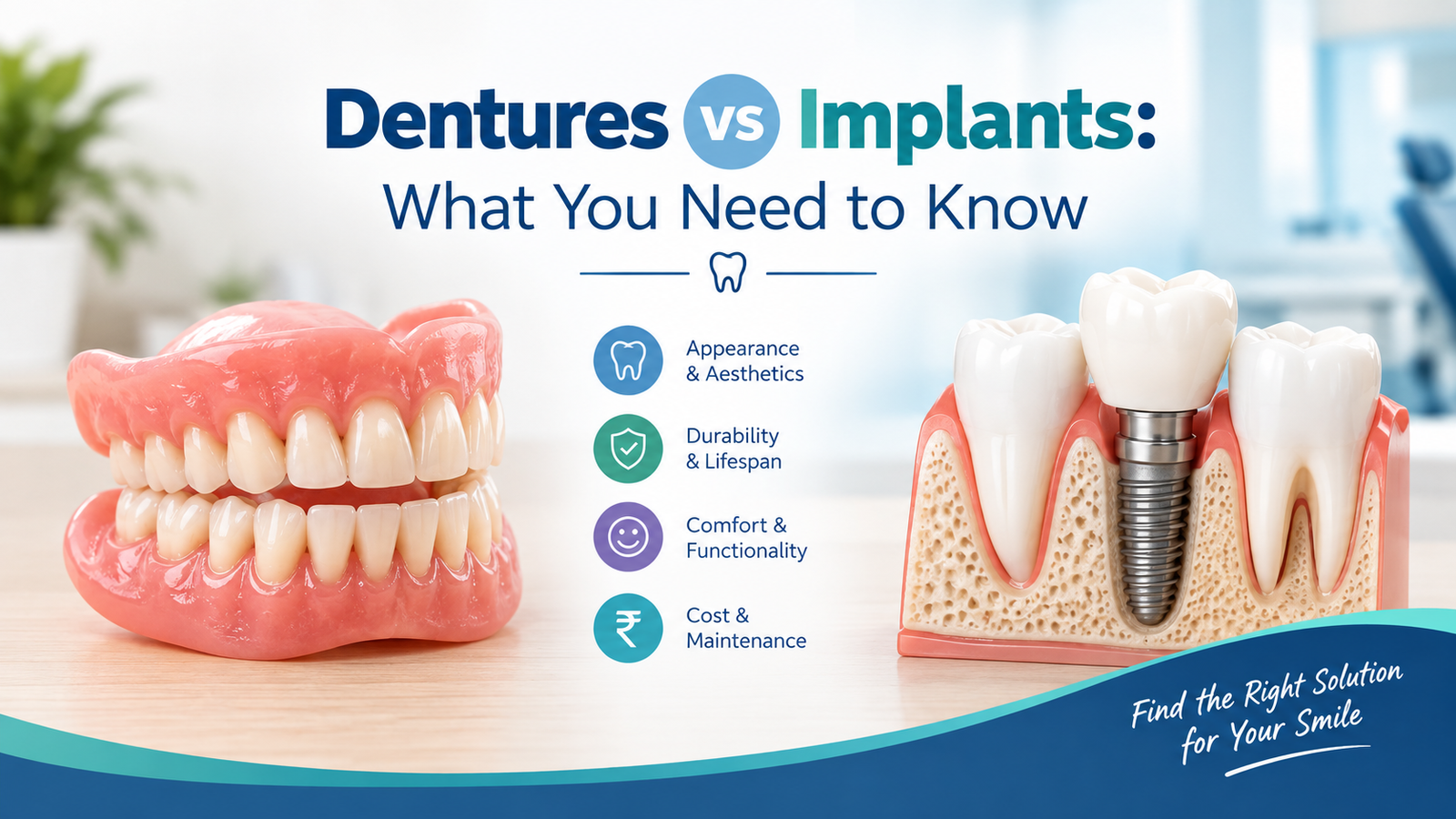
Dentures vs Implants: What You Need to Know
Losing one or more teeth can affect much more than your smile. Missing teeth can make it difficult to chew, affect your speech, change your facial appearance, and sometimes reduce your confidence. Fortunately, modern dentistry offers several effective ways to replace missing teeth.
Two of the most common options are dentures and dental implants. But which one is right for you?
At Dentsee Dental Clinic, we believe that every patient deserves a treatment plan based on their oral health, lifestyle, expectations, and budget. In this guide, we explain the key differences between dentures and dental implants so you can have a more informed discussion with your dentist.
What Are Dentures?
Dentures are removable dental appliances designed to replace missing teeth. Depending on the number of teeth you have lost, your dentist may recommend complete dentures or partial dentures.
- Complete dentures replace all the teeth in the upper or lower jaw.
- Partial dentures replace several missing teeth while fitting around your remaining natural teeth.
Modern dentures are designed to look natural and can significantly improve your ability to smile, speak, and eat.
Advantages of Dentures
Dentures may be a suitable option because they:
- Can replace multiple missing teeth at once
- Are generally more affordable than implants
- Do not usually require implant surgery
- Can restore your smile and facial appearance
- Can be a practical option when there is significant bone loss
- Can be removable for cleaning and maintenance
However, dentures can take some time to get used to. They may also move slightly while eating or speaking, particularly if they are not properly fitted.
What Are Dental Implants?
Dental implants are a more permanent tooth-replacement option. An implant consists of a small titanium or other biocompatible post that is placed into the jawbone. After the implant integrates with the bone, it can support a dental crown, bridge, or denture.
Because the implant is anchored in the jawbone, it functions more like a natural tooth root than a conventional removable denture.
Advantages of Dental Implants
Dental implants can offer several benefits:
- A more secure and stable solution
- A natural-looking appearance
- Improved chewing ability
- No need to remove the replacement tooth for routine use
- Helps maintain stimulation of the jawbone
- Does not require adhesive to stay in place
- Can provide a long-term tooth-replacement solution with proper care
However, implants involve a surgical procedure and require adequate bone and healthy gums. In some cases, additional procedures may be recommended before implant placement.
Dentures vs Implants: Key Differences
| Feature | Dentures | Dental Implants |
| Removable | Yes | Usually no |
| Stability | May move slightly | Highly stable |
| Surgery required | Usually no | Yes |
| Chewing efficiency | Improved, but may be limited | Generally closer to natural teeth |
| Bone preservation | Does not prevent normal bone resorption | Helps preserve bone around the implant |
| Maintenance | Requires removal and cleaning | Brushed and cared for like natural teeth |
| Initial cost | Generally lower | Generally higher |
| Treatment time | Often shorter | Can take several months depending on healing |
| Longevity | May need replacement or adjustment over time | Can be a long-term solution with proper care |
Which Is Better: Dentures or Implants?
There is no single answer because the best treatment depends on your individual situation.
Dentures may be appropriate if:
- You need to replace several or all missing teeth.
- You prefer a removable solution.
- You want a more budget-friendly option.
- You are not a suitable candidate for implant surgery.
- You have significant bone loss or other factors that make implants more complex.
Dental implants may be appropriate if:
- You want a fixed tooth-replacement option.
- You have sufficient bone or can undergo bone augmentation when appropriate.
- Your gums and overall oral health are suitable for implant treatment.
- You want a solution that feels and functions more like natural teeth.
- You are looking for a long-term tooth-replacement option.
In some situations, implant-supported dentures can provide a middle ground. Instead of resting only on the gums, the denture is secured using dental implants, which can improve stability and comfort.
Are Dental Implants More Comfortable Than Dentures?
Many patients find implants more comfortable because they are fixed in position and do not move around like conventional removable dentures can.
That said, modern dentures can also be comfortable when they are accurately designed, fitted, and regularly adjusted. Comfort depends on several factors, including the fit of the appliance, your oral anatomy, and how well you adapt to it.
If your dentures feel loose, cause sore spots, or make chewing difficult, speak to your dentist rather than continuing to tolerate the discomfort.
How Long Do Dentures and Implants Last?
The lifespan of either option depends on your oral hygiene, lifestyle, general oral health, and regular dental care.
Dentures may require adjustments, relining, or replacement over time as the shape of the gums and jaw changes.
Dental implants are designed as a long-term solution. However, the crown or other restoration attached to an implant may eventually need repair or replacement. Good oral hygiene and regular dental check-ups are essential for maintaining the health of the implant and surrounding tissues.
What About the Cost?
Cost is an important consideration when choosing between dentures and implants. However, the final cost varies from patient to patient.
It can depend on:
- The number of teeth being replaced
- The type of denture or implant restoration
- The condition of your gums and jawbone
- Whether bone grafting or other procedures are required
- The materials used
- The complexity of your treatment
Instead of choosing a treatment based only on price, it is important to consider comfort, functionality, durability, maintenance, and long-term oral health.
At Dentsee Dental Clinic, your dentist can assess your teeth, gums, jawbone, and overall oral health before recommending the most appropriate option.
Can You Get Dental Implants If You Have Bone Loss?
Bone loss does not automatically mean that implants are impossible.
When a tooth is missing for a long period, the jawbone in that area can gradually shrink. Depending on the extent and location of the bone loss, your dentist may recommend procedures such as bone grafting before or during implant treatment.
A detailed dental examination and appropriate imaging are necessary to determine whether implants are suitable for you.
How Do You Choose the Right Option?
Choosing between dentures and implants should be a personalised decision.
During a dental consultation, your dentist may consider:
- How many teeth you have lost
- The condition of your remaining teeth
- Your gum health
- The amount of available jawbone
- Your overall health and suitability for surgery
- Your lifestyle and comfort preferences
- Your treatment expectations
- Your budget and long-term goals
Rather than deciding based on what worked for a friend or family member, it is best to have your own teeth and oral health evaluated by a dental professional.
Take the First Step Towards a Confident Smile
Missing teeth do not have to affect your confidence or quality of life. Dentures and dental implants can both restore missing teeth, but they work in different ways and have different advantages.
The right choice depends on your individual oral health, needs, expectations, and long-term goals.
If you are considering dentures or dental implants in Pune, consult the dental team at Dentsee Dental Clinic for a personalised assessment. A professional evaluation can help you understand your options and choose a treatment plan that is appropriate for your smile.
Frequently Asked Questions
- Are implants better than dentures?
Not necessarily. Implants offer greater stability and function more like natural tooth roots, while dentures can be a practical, less invasive, and more affordable option for many patients. The right choice depends on your individual needs. - Are dentures painful?
New dentures can feel unusual initially, and some patients may experience temporary soreness while adjusting. A well-fitted denture should be comfortable. Persistent pain or irritation should be checked by your dentist. - Are dental implants painful?
Implant placement is performed using appropriate local anaesthesia, so patients generally should not feel pain during the procedure. Some soreness or swelling can occur during the healing period. - Can dentures look natural?
Yes. Modern dentures can be designed to closely match natural teeth and gums, providing a natural-looking smile. - How do I know whether I am suitable for dental implants?
Your dentist will evaluate your gums, jawbone, remaining teeth, medical history, and overall oral health. Dental imaging may also be required to assess the proposed implant site. - Can I replace all my teeth with implants?
Yes, there are several implant-based approaches for patients who have lost most or all of their teeth. Your dentist can determine which approach is appropriate based on your individual condition. - Should I choose dentures or implants?
The best option varies from person to person. A consultation with a qualified dentist is the best way to understand which treatment is suitable for your oral health, lifestyle, and goals.