
Dental Implants in Pune: What Makes Some Implants Last Decades?
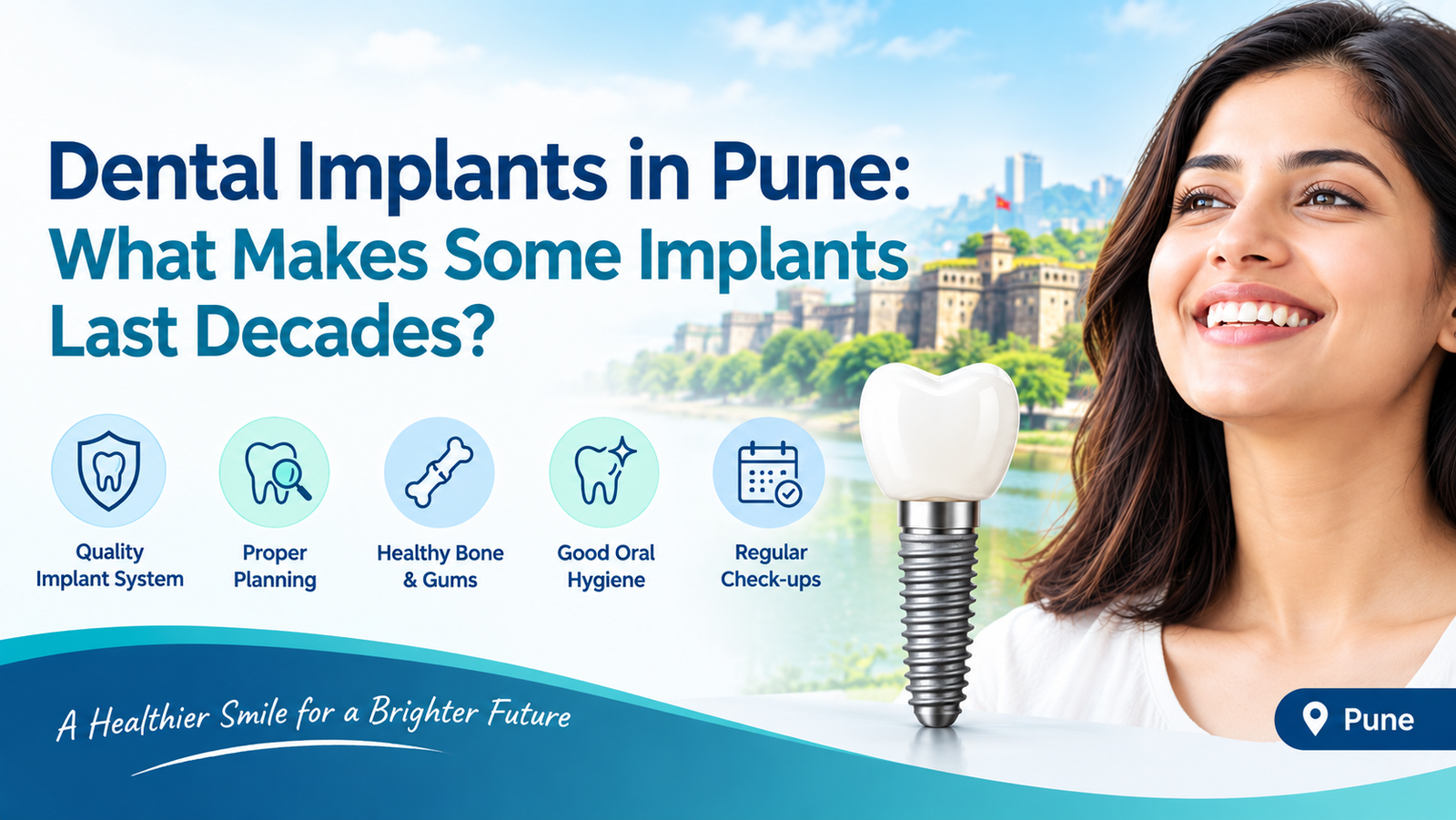
Dental Implants in Pune: What Makes Some Implants Last Decades?
Losing a tooth can affect much more than your smile. Missing teeth may make chewing difficult, affect speech, and gradually influence the way the surrounding teeth and jawbone function. Dental implants are one of the most reliable long-term options for replacing missing teeth because they are designed to replace both the tooth root and the visible crown.
But an important question many patients ask is: Why do some dental implants last for decades while others require replacement much sooner?
The answer depends on several factors—including implant quality, treatment planning, bone health, surgical technique, oral hygiene, lifestyle habits, and regular dental check-ups.
If you are considering dental implants in Wakad Pune, understanding these factors can help you make a more informed decision.
What Are Dental Implants?
A dental implant is a small, screw-shaped post, usually made from biocompatible titanium or another suitable implant material. It is surgically placed into the jawbone to act as an artificial tooth root.
A typical implant restoration has three main components:
- Implant fixture: The portion placed inside the jawbone.
- Abutment: The connector between the implant and crown.
- Dental crown: The visible tooth-shaped restoration designed to restore appearance and function.
Once the implant integrates with the surrounding bone, it can provide a stable foundation for a replacement tooth.
How Long Can Dental Implants Last?
Dental implants can potentially last for decades with appropriate care. However, implant longevity is not guaranteed for every patient.
It is useful to distinguish between the implant fixture and the dental crown. The implant itself can remain functional for many years, while the crown may eventually need repair or replacement because it is exposed to chewing forces and normal wear.
Several clinical and patient-related factors determine how long an implant restoration continues to function successfully.
- Quality of the Implant System Matters
Not all implant systems are identical. Reputable implant manufacturers invest in research, quality control, material science, and long-term clinical evaluation.
A high-quality implant should have:
- Biocompatible materials
- Appropriate surface characteristics
- Precise manufacturing
- Reliable implant-abutment connections
- Strong quality-control standards
When discussing dental implant treatment in Pune, patients should ask their dentist about the implant system being recommended and why it is suitable for their particular situation.
- Accurate Treatment Planning Is Essential
Successful implant treatment begins before the implant is placed.
Your dentist may evaluate:
- Jawbone quantity and quality
- Gum health
- Existing teeth
- Bite and chewing forces
- Sinus position in the upper jaw
- Nerve location in the lower jaw
- Overall oral health
- Medical and lifestyle factors
Digital imaging, including dental X-rays or 3D imaging when appropriate, can help the dental team assess the proposed implant site.
Good planning allows the implant to be positioned with the final restoration and surrounding tissues in mind.
- Adequate Jawbone Support
Dental implants depend on the surrounding bone for stability. After tooth loss, the jawbone can gradually shrink because it no longer receives the same stimulation from the tooth root.
If there is insufficient bone, additional procedures such as bone grafting may sometimes be considered before or during implant treatment.
However, whether bone augmentation is necessary depends on the individual patient’s anatomy and treatment plan.
- Healthy Gums Support Long-Term Implant Success
Healthy gum tissue is an important part of implant care.
Patients with untreated gum disease may have a higher risk of complications around implants. Bacteria and inflammation can affect the tissues supporting the implant.
Before placing an implant, dentists may recommend treating existing gum disease and improving oral hygiene.
After treatment, maintaining healthy gums remains important because inflammation around an implant can progress and compromise its supporting tissues.
- Precise Implant Placement
The position and angulation of an implant can influence the forces transferred to the implant and restoration.
A carefully planned implant placement aims to provide:
- Good stability
- Appropriate support for the crown
- Healthy surrounding tissues
- A functional bite
- A natural-looking result
Depending on the case, dentists may use digital planning and guided techniques to improve treatment precision.
- Your Bite and Chewing Forces Matter
Dental implants are designed to withstand normal chewing forces, but excessive or uneven forces may contribute to mechanical complications.
Patients who frequently grind or clench their teeth may place additional stress on implants and crowns.
If bruxism (teeth grinding) is present, your dentist may recommend protective measures such as a custom night guard.
Managing excessive bite forces can be particularly important when multiple implants or full-mouth restorations are involved.
- Good Oral Hygiene Makes a Major Difference
An implant cannot develop tooth decay in the same way as a natural tooth, but the surrounding gum and bone can still become infected.
Daily oral hygiene should therefore remain a priority.
Your routine may include:
- Brushing twice a day
- Cleaning between teeth
- Using floss or appropriate interdental aids
- Cleaning around implant-supported restorations
- Following your dentist’s recommendations
Your dental team can demonstrate the best cleaning technique for your specific implant restoration.
- Regular Dental Check-Ups Help Protect Implants
Dental implants should not be considered a “fit and forget” treatment.
Regular dental examinations allow your dentist to check:
- Implant stability
- Gum condition
- Bone support
- Crown condition
- Bite
- Plaque and tartar accumulation
- Signs of inflammation or other complications
Professional cleaning may also be recommended depending on your oral health.
Early detection of problems can make management easier and may help protect the implant.
- Smoking Can Affect Implant Health
Smoking can negatively affect oral tissues and healing. It is also associated with an increased risk of complications around dental implants.
If you smoke, discuss this honestly with your dentist before undergoing implant treatment. Your dentist can explain how smoking may influence healing and long-term implant health.
Quitting or reducing tobacco use can provide important benefits for overall oral health as well.
- The Crown Also Needs Care
Even when the implant fixture remains healthy, the crown attached to it can experience normal wear and tear.
The crown may eventually require:
- Polishing
- Repair
- Adjustment
- Replacement
This does not necessarily mean that the implant itself has failed.
A well-maintained implant with a properly cared-for restoration can continue functioning for many years.
Why Do Some Dental Implants Last for Decades?
There is rarely one single reason for exceptional implant longevity. Instead, long-lasting results usually come from a combination of factors:
Quality implant + proper planning + healthy bone and gums + precise placement + suitable restoration + good oral hygiene + regular follow-up = better long-term outcomes.
The patient’s habits are just as important as the dental procedure itself.
What Can Cause Dental Implant Failure?
Although dental implants have high long-term success rates, complications can occur.
Possible factors include:
- Poor oral hygiene
- Untreated gum disease
- Smoking
- Insufficient bone support
- Excessive bite forces
- Poorly fitting restoration
- Infection around the implant
- Certain medical or healing-related factors
- Failure to attend recommended follow-up appointments
Implant failure can occur at different stages, so a dental professional should evaluate any pain, swelling, looseness, bleeding, or discomfort around an implant.
Dental Implants vs. Traditional Tooth Replacement
Dental implants have several advantages compared with some conventional tooth-replacement options.
| Feature | Dental Implant | Traditional Bridge | Removable Denture |
| Replaces tooth root | Yes | No | No |
| Fixed restoration | Usually | Yes | No |
| Helps preserve jawbone around implant site | Yes | No | No |
| Requires removal for cleaning | No | No | Usually |
| Can provide strong chewing support | Yes | Yes | Varies |
The most appropriate option depends on the patient’s oral health, number of missing teeth, bone condition, budget, and personal preferences.
Who May Be a Candidate for Dental Implants?
Many adults with one or more missing teeth may be candidates for implant treatment. However, suitability must be assessed individually.
A dental implant consultation may be appropriate if you:
- Have one or more missing teeth
- Want a fixed tooth replacement
- Have adequate bone or may be suitable for bone augmentation
- Have healthy or treatable gums
- Are willing to maintain good oral hygiene
- Want to improve chewing and smile aesthetics
A dentist can assess your mouth and recommend an appropriate treatment plan.
What Is the Dental Implant Process?
Although the exact process varies, implant treatment generally involves several stages.
Step 1: Consultation
Your dentist evaluates your teeth, gums, bite, and overall oral condition.
Step 2: Diagnostic Imaging
Dental imaging may be used to evaluate bone levels and important anatomical structures.
Step 3: Treatment Planning
The dentist determines the implant position, restoration type, and whether additional procedures are required.
Step 4: Implant Placement
The implant fixture is surgically positioned in the jawbone.
Step 5: Healing and Integration
The implant is allowed to integrate with the surrounding bone. The timeline varies between patients.
Step 6: Abutment and Crown
Once appropriate healing has occurred, the final restoration is attached to the implant.
Step 7: Maintenance
Regular dental visits and daily oral hygiene help maintain the implant and surrounding tissues.
How Much Do Dental Implants Cost in Pune?
The cost of dental implants in Pune varies considerably because every treatment plan is different.
Factors that may influence the cost include:
- Number of implants required
- Implant brand and system
- Type of crown
- Bone grafting requirements
- Tooth extraction
- Diagnostic imaging
- Complexity of the case
- Type of implant-supported restoration
Instead of choosing an implant solely based on the lowest price, patients should consider the dentist’s experience, treatment planning, implant system, restoration quality, hygiene protocols, and aftercare.
A consultation is the best way to understand the treatment requirements and estimated cost for an individual case.
Why Choose DentSee Dental Clinic for Dental Implants in Pune?
At DentSee Dental Clinic, implant treatment is approached with attention to diagnosis, treatment planning, functional requirements, aesthetics, and long-term maintenance.
The goal is not simply to replace a missing tooth but to develop a restoration that fits comfortably into your bite and supports your oral health.
Patients considering dental implants can discuss their concerns, treatment options, expected timeline, and maintenance requirements during a dental consultation.
Final Thoughts
Dental implants can be an excellent long-term solution for missing teeth, but their longevity depends on much more than the implant itself.
High-quality materials, careful treatment planning, adequate bone support, healthy gums, precise placement, a properly designed restoration, good oral hygiene, and regular dental care all contribute to long-lasting results.
If you are searching for dental implants in Pune, consult an experienced dental professional to determine whether implants are appropriate for your needs. A personalized evaluation can help you understand the available options and develop a treatment plan focused on both function and long-term oral health.
Frequently Asked Questions
- How long can dental implants last?
Dental implants can function for many years and potentially decades when properly planned, placed, and maintained. Individual results vary. - Do dental implants last forever?
No dental treatment can be guaranteed to last forever. The implant fixture may remain functional for decades, while the crown may eventually require replacement due to normal wear. - Are dental implants painful?
Implant placement is performed using local anesthesia, so significant pain during the procedure is generally not expected. Some soreness or swelling can occur during recovery. - Can smokers get dental implants?
Smoking does not automatically rule out implant treatment, but it can negatively affect healing and increase the risk of complications. Your dentist can discuss the risks and appropriate steps before treatment. - Can dental implants prevent bone loss?
Implants transfer functional forces to the jawbone and can help maintain bone at the implant site compared with leaving the area without a tooth root. They cannot necessarily prevent all bone changes. - How do I take care of dental implants?
Brush twice daily, clean between your teeth and around the implant restoration, follow your dentist’s hygiene recommendations, and attend regular dental check-ups. - Are dental implants better than dentures?
Neither option is universally better. Implants can provide fixed support and may offer advantages for stability, while dentures may be appropriate for patients who prefer a removable option or are not suitable for implants. - How do I know if I am suitable for dental implants?
A dentist needs to evaluate your gums, bone, bite, overall oral health, and individual treatment requirements before determining whether implants are appropriate. - What happens if an implant becomes loose?
A loose implant or restoration should be evaluated by a dentist promptly. Do not continue putting excessive pressure on it until it has been assessed. - Where can I get dental implants in Pune?
Patients looking for dental implant treatment can consult DentSee Dental Clinic for an evaluation, treatment options, and a personalized implant plan.